David Foster Wallace y Jonathan Franzen.


-Este discurso que Jonathan Franzen dio en la Universidad de Kenyon sobre el amor en los tiempos del "me gusta" merece mucho la pena:

"This is not to say that love is only about fighting. Love is about bottomless empathy, born out of the heart’s revelation that another person is every bit as real as you are. And this is why love, as I understand it, is always specific. Trying to love all of humanity may be a worthy endeavor, but, in a funny way, it keeps the focus on the self, on the self’s own moral or spiritual well-being. Whereas, to love a specific person, and to identify with his or her struggles and joys as if they were your own, you have to surrender some of your self.

The big risk here, of course, is rejection. We can all handle being disliked now and then, because there’s such an infinitely big pool of potential likers. But to expose your whole self, not just the likable surface, and to have it rejected, can be catastrophically painful. The prospect of pain generally, the pain of loss, of breakup, of death, is what makes it so tempting to avoid love and stay safely in the world of liking.

And yet pain hurts but it doesn’t kill. When you consider the alternative — an anesthetized dream of self-sufficiency, abetted by technology — pain emerges as the natural product and natural indicator of being alive in a resistant world. To go through a life painlessly is to have not lived. Even just to say to yourself, “Oh, I’ll get to that love and pain stuff later, maybe in my 30s” is to consign yourself to 10 years of merely taking up space on the planet and burning up its resources. Of being (and I mean this in the most damning sense of the word) a consumer."

  
-Y sobre el amor y su amigo el escritor David Foster Wallace habla aquí:  

"He was lovable the way a child is lovable, and he was capable of returning love with a childlike purity. If love is nevertheless excluded from his work, it’s because he never quite felt that he deserved to receive it. He was a lifelong prisoner on the island of himself. What looked like gentle contours from a distance were in fact sheer cliffs. Sometimes only a little of him was crazy, sometimes nearly all of him, but, as an adult, he was never entirely not crazy. What he’d seen of his id while trying to escape his island prison by way of drugs and alcohol, only to find himself even more imprisoned by addiction, seems never to have ceased to be corrosive of his belief in his lovability. Even after he got clean, even decades after his late-adolescent suicide attempt, even after his slow and heroic construction of a life for himself, he felt undeserving. And this feeling was intertwined, ultimately to the point of indistinguishability, with the thought of suicide, which was the one sure way out of his imprisonment; surer than addiction, surer than fiction, and surer, finally, than love.”  


-Siempre me ha gustado esta frase de Dave Eggers sobre, como dice Franzen en su discurso, el error de aplazar o evitar el amor por algo o por alguien:

 “I will not wait to love as best as I can. We thought we were young and that there would be time to love well sometime in the future. This is a terrible way to think. It is no way to live, to wait to love.”


-Dave Eggers, What Is the What.


How We Are Hungry, Dave Eggers. 

Estas han sido mis últimas adquisiciones literarias:


The Feminine Mystique, Betty Friedan.

To Kill a Mockingbird, Harper Lee.

The Blind Assassin, Margaret Atwood. 

The Great Gatsby, F. Scott Fitzgerald. 


Kahlo, Andrea Kettenmann.

Klimt, Gilles Néret.

Y esto es lo que estoy leyendo... 


“Eleanor was right. She never looked nice. She looked like art, and art wasn't supposed to look nice; it was supposed to make you feel something."

Eleanor and Park, Rainbow Rowell.


Rehtaeh Parsons tenía 15 años cuando fue violada por cuatro compañeros de clase. Compañeros contra los que, a pesar de que distribuyeron una foto de los hechos a través de Internet, nunca se presentaron cargos. A partir de ese momento la joven fue acosada sin cesar en su instituto y a través de las redes sociales, lo que la llevó a cambiar de colegio y la sumió en una profunda depresión. Hace algo más de una semana se suicidó. 

Rehtaeh no es la primera víctima de esta cultura de la violación en la que vivimos, en la que se culpa a la víctima y se disculpa a los agresores. Lo vimos con Amanda Todd y con Audrie Pott. Lo vimos con Steubenville y la vergonzosa cobertura de la CNN, en la cual la reportera lamentaba el hecho de que las vidas de los violadores habían quedado arruinadas. 

Es triste y frustrante ver el nulo respeto que la sociedad tiene por las mujeres, lo poco que valemos en un mundo que nos ve y nos trata como objetos. Como dice Hila Shachar en su último post: "I just can’t even begin to express the sense of rage I feel when I read these stories. And it feels like indulgent rage sometimes because I’m not one of these women who have been raped, and I’m not a member of their families dealing with the aftermath of their death. But this rage nevertheless exists. It’s a rage that comes from a feeling of complete uselessness and hopelessness, and it’s also a rage to do with the fact that I recognise how little I’m worth as a woman in the world as it is. You know what reading these stories says to every woman and girl? It says this:

You are a piece of shit. You are not a person, you are a thing. You are worthless."

Nos debemos a nosotras mismas el no quedarnos calladas, y se lo debemos a ellas. Infórmate, edúcate y actúa: 

-Te han violado, así que debes de ser una puta. 

-So much pretty by Cara Hoffman: "First you’re taught to fear a phantom, a man in black, a man with a knife, a man who’ll pounce in dark alleys. Well-intentioned women—mothers, aunts, teachers—will train you to protect yourself: Don’t wear your hair in a ponytail; it’s easier to grab. Hold your keys in one hand; hold your pepper spray in the other. Avoid dark alleys. When you reach young adulthood, the lessons change. They acquire an undertone of disgust: Don’t drink so much. Don’t wear such short skirts. You’re sending mixed signals; you’re putting yourself at risk.
If you follow the advice and it never happens—if you end up one of the three out of four—you can convince yourself that safety is a product of your own making, a reflection of inherent goodness. But if you’re paying attention, you realize something doesn’t add up. Because it keeps happening: to your sisters; to your friends; to little girls and grown women you’ll never meet, in places like Cleveland, Texas; Steubenville, Ohio; New Delhi. Good people, bad people, neutral. It keeps happening in TV shows and novels and movies—they open on the missing girl, the dead girl, the raped girl. If you’re paying attention, you begin to realize that it isn’t happening. It is being done. And you are not safe. You have never been safe. You were born with a bulls-eye on your back. All you have ever been is lucky."

-Rape culture and the media.

-Toxic Masculinity. 

-So you're tired of hearing about rape culture?

-I’m getting sick of the term friendzone.

-Only 'Yes' Means Yes: What Steubenville's Rape Trial Reminds Us About Sexual Consent.

-Rehtaeh Parsons is dead: "Instead of wallowing in injustice, let’s finally wake up from the delusion that we have any more time to waste. Rape culture kills. Rehtaeh Parsons is dead and we are in a state of emergency.

Organize your neighborhood or school against rape culture: run consent education workshops and recruit participants to pledge their stance against violence. March, demonstrate, to publicly prove to all that those who inflict violence on others will not be supported or included by your community. Every time a publication runs a piece promoting rape culture, write a letter in response. Reject slut-shaming and victim-blaming of all forms. Loudly. Model respect for others’ bodily autonomy and stand up for your own in everyday situations to promote a culture of consent. Intervene if you see a dangerous situation developing, and teach others to do the same. Combat the transmission of rape culture from one generation to the next: teach kids to be better than we are. Don’t invite rapists to your parties (I can’t believe I even have to say that, but I do). Make sure survivors in your area have somewhere to turn for justice and support, and to stop their rapists from re-offending. If this resource doesn’t exist, create it. Refuse to tolerate speech that promotes rape; speak up even–no, especially–when to do so would be rude. Listen to a survivor when no one else will."


La chica que escribe este (muy interesante) blog ha iniciado un club de lectura en el que la única regla es comprometerse a leer y reseñar más libros escritos por mujeres, con el fin de potenciar el papel de estas en el ámbito literario. Como podéis ver en la foto de abajo, en mi lista de libros por leer abundan las autoras femeninas, así que no voy a tener ningún problema llevándolo a cabo. Si queréis saber más podéis informaros aquí, y si queréis uniros solo tenéis que poner en vuestro blog este banner. 


Cuando me encontré con este set de 100 postales, cada una de ellas evocando la portada de un libro publicado por la famosa editorial Penguin, no me pude resistir. Ahora Virginia Woolf, Emily Brontë, Oscar Wilde y Scott Fitzgerald cuelgan de la pared de mi habitación (si queréis hacer lo mismo que yo solo necesitáis un poco de cuerda, fiso (o washi tape, que queda más mona), y unas mini pinzas de colores. 


Mi lata molona para guardar los materiales.


Esta es mi cuarta lectura del 2013 (que estoy devorando en mi recién estrenado Kindle). Gone Girl fue todo un éxito el pasado año (creo que ya se está preparando la peli), y la verdad es que me tiene superintrigada. Antes leí Matched, la primera parte de una trilogía distópica que no me terminó de convencer. 


Y, en otro orden de cosas, estoy completamente obsesionada con Mumford & Sons: 


Esta es, probablemente, la carta más romántica jamás escrita:


25 College Street


My dearest Girl,

This moment I have set myself to copy some verses out fair.  I cannot proceed with any degree of content.  I must write you a line or two and see if that will assist in dismissing you from my Mind for ever so short a time.  Upon my Soul I can think of nothing else - The time is passed when I had power to advise and warn you again[s]t the unpromising morning of my Life - My love has made me selfish.  I cannot exist without you - I am forgetful of every thing but seeing you again - my Life seems to stop there - I see no further.  You have absorb'd me. I have a sensation at the present moment as though I was dissolving - I should be exquisitely miserable without the hope of soon seeing you.  I should be afraid to separate myself far from you.  My sweet Fanny, will your heart never change?  My love, will it?  I have no limit now to my love - You note came in just here - I cannot be happier away from you - 'T is richer than an Argosy of Pearles.  Do not threat me even in jest. I have been astonished that Men could die Martyrs for religion - I have shudder'd at it - I shudder no more - I could be martyr'd for my Religion - Love is my religion - I could die for that - I could die for you.  My Creed is Love and you are its only tenet - You have ravish'd me away by a Power I cannot resist: and yet I could resist till I saw you; and even since I have seen you I have endeavoured often "to reason against the reasons of my Love."  I can do that no more - the pain would be too great - My Love is selfish - I cannot breathe without you.

Yours for ever
John Keats


Este libro recoge todos los poemas y cartas que Keats le escribió a Fanny Brawne, y la preciosa película Bright Star cuenta su historia de amor. 


"No one would take me just as I was, no one loved me; I shall love myself enough, I thought, to make up for this abandonment by everyone. Formerly, I had been quite satisfied with myself, but I had taken very little trouble to increase my self-knowledge; from now on, I would stand outside myself, watch over and observe myself; in my diary I had long conversations with myself. I was entering a world whose newness stunned me. I learned to distinguish between distress and melancholy, lack of emotion and serenity; I learned to recognize the hesitations of the heart, and its ecstasies, the splendor of great renunciations, and the subterranean murmurings of hope. I entered into exalted trances, as on those evenings when I used to gaze upon the sky full of moving clouds behind the distant blue of the hills; I was both the landscape and its beholder: I existed only through myself, and for myself… My path was clearly marked: I had to perfect, enrich and express myself in a work of art that would help others to live."

-Simone de Beauvoir.


El número de febrero de Proyecto Kahlo ya ha visto la luz, y este mes mi colaboración va sobre amor y libros: 
"El amor es el protagonista de las novelas que hoy os traigo, cinco libros muy diferentes entre sí, que narran romances atípicos y evitan con éxito los tópicos. Eso sí, no os garantizo que haya final feliz:
1) Expiación (Ian McEwan): La imaginación, envidia y orgullo de Briony hacen que el romance de su hermana con Robbie Turner acabe en tragedia para los tres protagonistas, incluyéndola a ella. Una historia sobre el remordimiento y el peso del pasado, que cuenta con una muy recomendable adaptación cinematográfica.
2) Siempre el mismo día (David Nicholls): Nicholls cuenta la historia de Dexter y Emma relatando lo que ocurre en sus vidas el 15 de julio de cada año durante los veinte siguientes al de su graduación. Una joya sobre la madurez, y lo que significa crecer y ver como aquellos a quienes quieres cambian, cuya adaptación a la gran pantalla está protagonizada por Anne Hathaway y Jim Sturgess.
3) Delirium (Lauren Oliver): Una distopía, el género de moda en la literatura juvenil actual. En el mundo de Delirium el amor es una enfermedad que debe ser erradicada, pero Lea, la protagonista,  pronto se da cuenta de que prefiere estar infectada a vivir una vida basada en la mentira.  La historia se materializa en una trilogía, cuyo último volumen, Requiem, verá la luz en marzo de 2013".

Si queréis saber cuáles son los otros dos, podéis seguir leyendo aquí. 


Imágenes vía Bombas para desayunar.


Acaba de salir a la venta el fanzine de temática  feminista Feminizine 2, en el que colaboro con un artículo titulado "La objetualización de la mujer en los medios de comunicación". Os animo a haceros con él, y os dejo un extracto de mi colaboración:


"La música, el cine, la publicidad, y los medios de comunicación en general, están muy presentes en nuestro día a día y, aunque no siempre seamos conscientes de ello, tienen un gran impacto en nuestra forma de pensar y de percibir la realidad. Les hemos dado el poder de establecer lo que es ideal y deseable, y dado que cada vez estamos más expuestos a contenido sexista, más se percibe por parte de la sociedad a la mujer como un mero objeto y más se acepta su discriminación como algo natural.

Las mujeres son objetualizadas y desmembradas en la publicidad de forma continua.  El desmembramiento se produce en aquellos casos en que  aparece únicamente una parte del cuerpo de la mujer, separándola así del resto de la persona e implicando que toda la importancia de esta última reside en ella. La objetualización consiste en que la mujer aparece retratada como un simple instrumento. De esta forma, es habitual ver a la mujer desnuda frente al hombre vestido, a mujeres infantilizadas o en situaciones de sumisión o vulnerabilidad, representadas como un mero objeto pasivo para el placer ajeno. 

Cuanto más habituales son la objetualización y la desmembración más internalizamos la normalidad de una práctica que tiene graves consecuencias tanto en la manera en que las mujeres se relacionan con sus cuerpos como la forma en que la sociedad las percibe, dando lugar a trastornos alimentarios, problemas de autoestima, depresión (consecuencias internas), y fomentando la violencia sexista  o desacreditando a las mujeres en su actividad profesional (consecuencias externas)".


Si queréis seguir leyendo mi reflexión, y disfrutar de la gran cantidad de artículos interesantes, ilustraciones y collages que componen el fanzine, podéis comprarlo aquí, o informaros más en la página de Bombas para desayunar. 


*Actualización: Feminizine 2 ya está disponible para descargar en PDF.


-Heartburn, de Nora Ephron: “I married him against all evidence. I married him believing that marriage doesn't work, that love dies, that passion fades, and in so doing I became the kind of romantic only a cynic is truly capable of being.” 

-You Shall Know Our Velocity y A Hologram for the King, de Dave Eggers: “You can't ever guess at life, at pain. All pain is real, and all pain is personal. It's the most personal thing we have. It eats each of us differently.” You Shall Know Our Velocity. 

-Dear Diary, de Lesley Arfin: “Ever notice how amused people are when you point out one of their mannerisms or a funny quirk about them? They start laughing and getting happy because they're thinking, "People notice me! I'm relevant!" It's OK to have these instincts, but you have to suppress them a bit. There are 6 billion people here, so it's not all about you. You need to let other people talk for a while and pay attention to their world for a sec.” 

-Las últimas partes de las sagas Divergent y Delirium (pendientes de publicación): “You can build walls all the way to the sky and I will find a way to fly above them. You can try to pin me down with a hundred thousand arms, but I will find a way to resist. And there are many of us out there, more than you think. People who refuse to stop believing. People who refuse to come to earth. People who love in a world without walls, people who love into hate, into refusal, against hope, and without fear. I love you. Remember. They cannot take it.” Delirium.  

-Igual les echo un ojo a las sugerencias de John Green en cuanto a literatura juvenil: Matched y Uglies. (También me tienta la saga Cazadores de sombras, de la que van a estrenar peli). 

-Algo de Jane Austen (No, aún no he leído nada de ella, a pesar de haber visto prácticamente todas las adaptaciones de la BBC de sus novelas).

-Algo de Foster Wallace (¿Alguna recomendación acerca de por dónde debería empezar?).

-Villette, de Charlotte Brontë: “To see and know the worst is to take from Fear her main advantage.” 

-The Poems of Charlotte Bronte, de Charlotte  Brontë. 

-A Room of One's Own, de Virginia Woolf: “Lock up your libraries if you like, but there is no gate, no lock, no bolt that you can set upon the freedom of my mind.”

-Cloud Atlas de David Mitchell: “A half-read book is a half-finished love affair.” 

-Atlas Shrugged, de Ayn Rand: “If you don't know, the thing to do is not to get scared, but to learn.” (Me he acordado de él al leer las razones de John Green para odiarlo).

-Sweet Tooth, de Ian McEwan: “I said I didn’t like tricks, I liked life as I knew it recreated on the page. He said it wasn’t possible to recreate life on the page without tricks.” 

-V for Vendetta, de Alan Moore: “Behind this mask there is more than just flesh. Beneath this mask there is an idea... and ideas are bulletproof.” 

-Rookie Yearbook One, de Tavi Gevinson. 


Y lo que vaya surgiendo (o me recomendéis). Si queréis saber qué es lo mejor que he leído este año podéis verlo aquí. 

¿Qué tenéis pensado leer vosotros?


Eggers y su mujer, la también escritora Vendela Vida. 

"I will not wait to love as best as I can. We thought we were young and that there would be time to love well sometime in the future. This is a terrible way to think. It is no way to live, to wait to love."
What is What-Dave Eggers


Estoy bastante un poco obsesionada con Dave Egggers y su primer libro (que ahora está sobre mi mesita de noche), A Heartbreaking Work of Staggering Genius. Se trata de unas memorias que narran su vida a los veintiún años, tras perder a su padre y a su madre en un breve espacio de tiempo y quedar al cuidado de su hermano pequeño. Fascinante y extraño, Eggers cuenta su historia (tomándose muchas libertades) de una forma que engancha.

El libro tiene más de una rareza:

"Height: 5'11"; Weight 175; Eyes: blue; Hair: brown; Hands: chubbier than one would expect; Allergies: only to dander; Place on the sexual orientation scale, with 1 being perfectly straight and 10 being perfectly gay: 3."


Reglas para la lectura

"His brain is my laboratory, my depository. Into it I can stuff the books I choose, the television shows, the movies, my opinion about elected officials, historical events, neighbors, passersby. He is my twenty-four-hour classroom, my captive audience, forced to ingest everything I deem worthwhile. He is a lucky, lucky boy! And no one can stop me.” 

“Because secrets do not increase in value if kept in a gore-ian lockbox, because one's past is either made useful or else mutates and becomes cancerous. We share things for the obvious reasons: it makes us feel un-alone, it spreads the weight over a larger area, it holds the possibility of making our share lighter. And it can work either way - not simply as a pain-relief device, but, in the case of not bad news but good, as a share-the-happy-things-I've-seen/lessons-I've-learned vehicle. Or as a tool for simple connectivity for its own sake, a testing of waters, a stab at engagement with a mass of strangers.” 

“You will die, and when you die, you will know a profound lack of it [dignity]. It's never dignified, always brutal. What's dignified about dying? It's never dignified. And in obscurity? Offensive. Dignity is an affectation, cute but eccentric, like learning French or collecting scarves. And it's fleeting and incredibly mercurial. And subjective. So fuck it."


Yo quiero dar fiestas así de guays

"I wanted to start a website for teenaged girls that was not kind of this one-dimensional strong character empowerment thing, because one thing that can be very alienating about a misconception of feminism in that girls then think that to be feminists they have to live up to being perfectly consistent in their beliefs, never being insecure, never having doubts, having all the answers... and this is not true and actually recognizing all the contradictions I was feeling became easier once I realized that feminism was not a rulebook but a discussion, a conversation, a process."

-Tavi Gevinson.


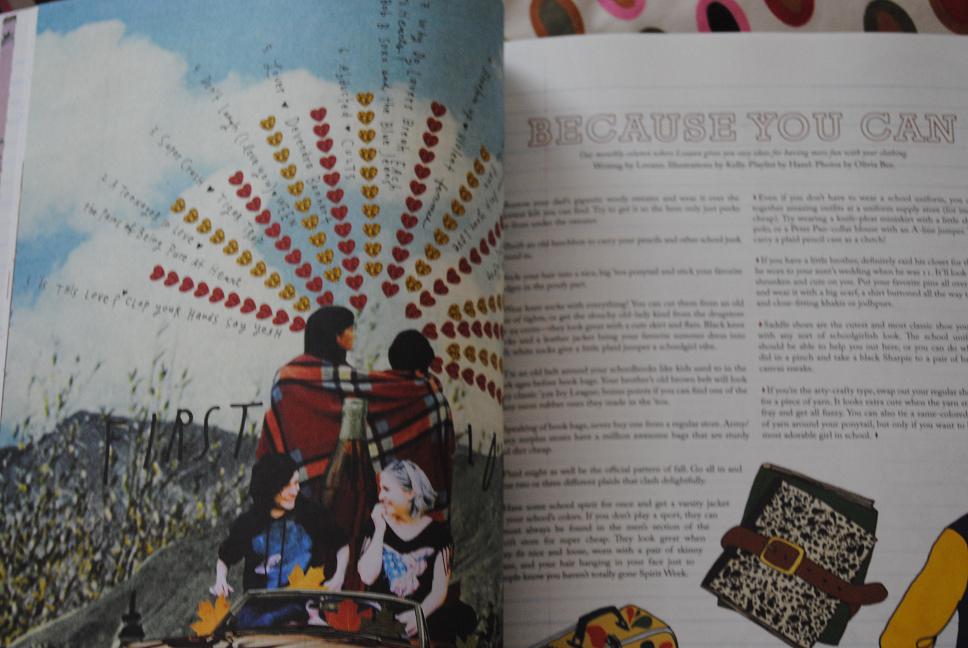
Oí hablar de Tavi Gevinson por primera vez cuando, con tan solo doce años, se colocó en primera línea de los desfiles de algunos de los diseñadores más importantes. Como no suelo leer demasiado sobre moda, no me la volví a encontrar hasta que fundó el magazine online Rookie, dirigido a chicas adolescentes (aunque es interesante también para las que hemos pasado de los quince), un rincón de lo más inspirador, lleno de artículos sobre esos complicados años, de DIYs, y de reportajes fotográficos estupendos. 

Su blog personal es una gozada para la vista, y la joven acaba de lanzar su primera publicación impresa, Rookie Yearbook One, que recoge algunos de los posts que han aparecido en su web durante el primer año de vida de la misma:


Y, además de todo esto, tiene las ideas muy claras. La charla que dio para Ted es genial: 


"As soon as teenage girls start to profess love for something, everyone else becomes totally dismissive of it. Teenage girls are open season for the cruelest bullying that our society can dream up. Everyone's vicious to them. They're vicious to each other. Hell, they're even vicious to themselves. It's terrible.   

It's used as the cheapest, easiest test of crap, isn't it? If teenage girls love a movie, a book, a band, then it's immediately classified as mediocre shit. Well, I'm not going to stand for that. Someone needs to treat them like they're precious, and if nobody else is ready to step up, I guess it's up to us to put them on the path to recognizing that about themselves."

-Mary Borsellino.

Como dicen los párrafos de arriba, tendemos a rechazar y ridiculizar todo aquello que apasiona a las adolescentes por el simple hecho de que lo son, cuando, si empezásemos a valorarlas como merecen, todos saldríamos ganando. Ellas porque necesitan ser escuchadas, y nosotros porque lo que tienen que decir importa, y mucho. 


Con la tecnología de Blogger.